Tag Archives: Frederick Glaysher

Two Reviews of The Parliament of Poets

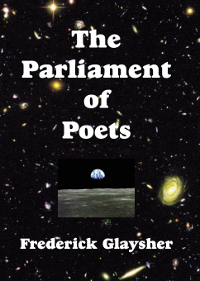
The Parliament of Poets: An Epic Poem

The Parliament of Poets: An Epic Poem

Two Reviews of The Parliament of Poets

Goodreads, Ratul Pal Jan 25, 2013

“Most of the contemporary poets and critics claim that epic is not suitable for our modern age. But Frederick Glaysher has proven them wrong. He has shown that if a poet has true dedication, if he has unshakable belief in humanity, spirituality and overall progress of human beings, if he hasn’t already surrendered himself to the ugliness of decadence, it is possible for him to write an epic, even in modern age. “The Parliament of Poets” has all the grandeur, all the loftiness and qualities which make an “effort for an epic” a “true epic”. In essence, “The Parliament of Poets” is a song of unity, an audacious declaration that unity does not mean conformity, it means being in harmony. The poet himself is the main character of this epic poem, who travels to the moon, meets a large number of great poets and writers of the world, comes back to earth to have some glimpses of bygone times. Throughout the entire journey, many poets, writers, sages guide the poet and share their invaluable knowledge and insights. Besides giving the pure joy of poetry, this epic will certainly enrich a reader’s geographical-political-architectural knowledge. If a reader is not already acquainted with some of the mainstream traditions of world-literature, it will be difficult for him to grasp the meaning this epic tries to convey. But we must remember that no great work of literature is self-sufficient. Great works of literature have a lot to offer, but in order to comprehend them, a reader must prepare himself, must sharpen his intelligence and aesthetic sense. Keeping these things in mind, anyone can start reading “The Parliament of Poets”.”

LibraryThing, “A wonderful book. As a fan of poetry and especially epic poetry I found this book to be up to the standards set by Homer. I met some new poets that I have looked up and added to my collection. This book also is very thought provoking as it brings into question what humanity is doing to the Earth and each other. I highly recommend it.”
( ) wtshehan | Oct 25, 2012

Read a free chapter, BOOK I, The Parliament of Poets: An Epic Poem
Frederick Glaysher

Leave a Comment

Filed under Epic

Decadence, East and West

Blue Water Planet

Blue Water Planet

Decadence, East and West

The scholar Jacques Barzun provides our initial definition of decadence, taken from his brilliant survey of intellectual history, From Dawn to Decadence: 1500 to the Present, 500 years of Western Cultural Life (2000): “All that is meant by decadence is ‘falling off.’” His discussion ranges over Western art, music, religion, and literature, documenting and critiquing the many figures, changes, and evolutions up to the reigning vision of our time, which he succinctly epitomizes while defending the term of his assessment: “When people accept futility and the absurd as normal, the culture is decadent. The term is not a slur; it is a technical label.” Barzun goes on to explain how one can identify when a culture declines into decadence:

“How does the historian know when Decadence sets in? By the open confessions of malaise, by the search in all directions for a new faith or faiths…. To secular minds, the old ideals look outworn or hopeless and practical aims are made into creeds sustained by violent acts….”

From this perspective, modern Western culture has been in free-fall for over a hundred years, arguably even longer. Whether high or low, such is the story of Western civilization, and, to the extent that it became modern civilization, its decadence has long been passed around the world, into the vitals of every regional civilization on the face of the earth. Together, we have all sunk into the dark pit of cynicism, frivolity, and despair, “fallen off” into nihilism….

Now available in

The Myth of the Enlightenment: Essays
Forthcoming, September, 2014.

https://www.earthrisepress.net/myth_of_the_enlightenment.html

Frederick Glaysher

Leave a Comment

Filed under Universality

Tagore and Literary Adaptation

rabindranath tagore

Rabindranath Tagore

Tagore and Literary Adaptation

Accidentally including three or four poems by another poet among his collection of short poems, Fireflies (Lekhan), what Tagore did was discussed in 2002, in a different context, by Richard Posner, in “On Plagiarism” in The Atlantic Monthly:

“…the writer who plagiarizes out of … forgetfulness, the latter being the standard defense when one is confronted with proof of one’s plagiarism.”

It was a mistake. Tagore immediately owned it. He was human, too, and graciously admitted he had erred, when it was pointed out to him, dealing with many manuscripts from years ago, jumbled together. Why should it be held against him by later sticklers?

Now available in

The Myth of the Enlightenment: Essays
Forthcoming, September, 2014.

https://www.earthrisepress.net/myth_of_the_enlightenment.html

Frederick Glaysher

Leave a Comment

Filed under Epic, Universality

Just Published in Kolkata, India, Rupkatha, Excerpt from Book IV

Just published in Kolkata, India > Excerpt from Book IV. Rupkatha Journal

Rupkatha Journal

Just published in Kolkata, India, Rupkatha, Excerpt from Book IV

Just published in Kolkata, India > Excerpt from Book IV. Rupkatha Journal, Volume IV, Number 2, 2012.

Tagore and the Poet, at Kurukshetra:

“We soon were over a plain, a wide field,
where two vast armies were ranked to battle,
legions on either side for war…”

Rupkatha.com

Direct PDF: rupkatha.com/V4/n2/Poetry_V4N2.pdf

Or available from my own server: Rupkatha_Poetry_V4N2_2012

Frederick Glaysher

Leave a Comment

Filed under Epic