Lezsek Kolakowski and the Children of Abraham
Leszek Kolakowski and the Children of Abraham
September 1, 2010
(I wrote this review in 1983 but never published it. I’ve decided to publish it now for a friend in Africa since it discusses the three major monotheistic religions stemming from Abraham. For a more recent piece on some of the same issues, also see, Tolstoy and the Last Station of Modernity.)
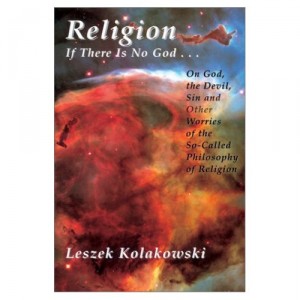
A Review of (1) F. E. Peter, Children of Abraham: Judaism, Christianity, Islam. Princeton University Press, 1982; and (2) Leszek Kolakowski, Religion: If there is no God. . . On God, the Devil, Sin and other Worries of the so-called Philosophy of Religion. Oxford University Press, 1982.
F. E. Peter’s book Children of Abraham offers an interesting and systematic treatment of the Jewish, Christian, and Islamic religions that demonstrates their essential unity. Professor Peters achieves this by concentrating on six areas that are outlined by his chapter titles: “Community and Hierarchy,” “The Law,” “Scripture and Tradition,” “The Liturgy,” “Asceticism and Mysticism,” and “Theology.” His intent is, as he states, “to illuminate how these affiliated religions approached common issues.” His perspective is one that holds the monotheistic religions as sharing the same source, attested by the opening paragraph of his book:
Judaism, Christianity, and Islam are all scriptural religions, that is, they affirm the existence of a divine revelation in written form. “The Sacred Writings,” “The Scripture” or “The Book” are practically interchangeable terms among the three, and their adherents can all be identified as “People of the Book,” as the Muslims in fact call them. More, these revelations from on high represent God’s intervention in history; and, indeed, the same God: the Jew’s Yahweh, the Christians’ God the Father who is in Heaven, and the Muslims’ Allah is one and the same deity, with the same history, the same attributes and, in fact, the same name.
This statement of their shared origin informs much of the discussion of Professor Peter’s book and enables him to cut through, as it were, the malignant growths of countless sectarian debates, animosities, and misperceptions.
His perception of their oneness surfaces again during his discussion of Islam:
What was understood to have happened was that a new prophet had appeared in the Judeo-Christian tradition and had promulgated a new revelation, or rather a new version of revelation, which had as its object not the abrogation of the old Law but its restoration to its original vigor.
Here his analysis probes the common origin, which Islam shares with Judaism and Christianity, and shows that, far from an entirely new revelation, Islam, as Christianity before it, marks the “restoration” of the “old Law” to its pristine purity. Conversely, his perspective aids him to discern common absurdities that mar the historical development of each religion:
And each community lived in the conviction that God had spoken to it for the last time: the Jews, for the first and final times; the Christians, for the second and final time; the Muslims, for the third and final time.
Although Peters does not expand on the illogicality of this conviction, such an idea is implicit in his work, given his emphasis on their shared origin.
The progressive universality of each dispensation is developed in his chapter “The Law”:
Moses was given the Law to modify pagan custom for the better, and so provide a bridge from idolatry to a belief in the unique God. . . . The Law appears, then—and most clearly in its cultic and sacrificial aspects—to be a transitional and ameliorative instrument rather than final and perfect, at least when viewed from a historical perspective.
Certainly this progressive bridge suffuses the Torah—the covenant code and the Book of the Kings document precisely the struggle with the “cultic and sacrificial aspects”—as well as the books of the prophets. But what is noteworthy here is Peter’s realization that the Law was not final and perfect but a transitional and ameliorative instrument—one that guided and directed the Jewish covenant community to belief in one God. Later, Peters also suggests that Muhammad provided this bridge for the pre-Islamic peoples by preserving “within the hajj [pilgrimage] a treasure-trove of early Semitic cult practice,” much as Christ had preserved aspects of the Jewish cultural background of his day.
Although the strongest point of Peter’s book is his demonstration of the shared origin of the revealed religions, it is also, paradoxically, the most conspicuous weakness. For Professor Peters, all religions are pretty much the same. There is a sense in which he never takes any issue seriously. His tone itself exudes skepticism, and one wonders if “common” in his vocabulary does not often carry a pejorative nuance. And although he claims objectivity and rationality, his biases are those of what he calls a “secular historican,” one who believes categorically that all religions ultimately and merely amount to a struggle for political power.
Leszek Kolakowski’s book Religion concentrates on exactly the issue that Peters refuses to consider, whether or not God exists. By quickly surveying the history of the philosophy of religion, Professor Kolakowski covers both the major critiques of religious belief and the major counter-arguments of such philosophers as Descartes, Leibniz, and Pascal. He also discusses theodicy, skepticism and mysticism, eternity and inevitable human failure, reason and eros, the relationship of knowledge and language, and the link between belief in God and death. Despite the expansive sweep of his discussion, his concerns find their center in his oft-repeated thesis:
I take the act of worship as unremovable and instrinsic to any description of the phenomenon of religion. The socially established worship of the eternal reality: this formulation comes perhaps closest to what I have in mind when talking of religion.
Though he marshalls what Abdul-Baha calls in Some Answered Questions the “proofs and demonstrations of the existence of God,” Kolakowski believes the act of worship to be superior to all such arguments—as Abdul-Baha put it, “When man feels the indwelling spirit, he is in no need of arguments for its existence.” But to stop at this observation would be to ignore much of what is of value in Kolakowski’s book. For one thing, his definition of religion as “the socially established worship of the eternal reality” refutes the conception of an individual faith that can be separated from the communal matrix. Religion, by its very nature, presupposes social cohesion—albeit a cohesion enigmatically based on individual worship.
Kolakowski further elaborates his definition in the following passage:
Religion is not a set of propositions, it is the realm of worship wherein understanding, knowledge, the feeling of participation in the ultimate reality . . . and moral commitment appear as a single act, whose subsequent segregation into separate classes of metaphysical, moral and other assertions might be useful but is bound to distort the essense of the original act of worship.
He convincingly makes the case that religion is not merely a “set of propositions” or rational constructs; rather, it is, as he states elsewhere, “a way of life.” And although the human mind is capable of analyzing its act of worship, of separating it into metaphysical, moral, social, and rational elements, of looking at the mountain, the mind cannot comprehend either itself or the mystery it contemplates. Far from constituting a flight into vague irrationality, Kolakowski’s position asserts the fundamental difference between religious and empirical or scientific truth. This difference is basically one of validation: “The only reliable access to religious truth is by way of a private experience which cannot be satisfactorily rendered in intersubjective discourse.” Yet modern science asserts its now “fanatical rationalism” by affirming self-assuredly “what is or is not knowledge.”
Kolakowski’s position, like that of all Christian apologists of the 20th Century, is an embattled one. He himself recognizes the fact and acknowledges at length the decline of religious belief over the last century or so. His emphasis throughout the book on “two irreconcilable ways of accepting the world and our position in it” would largely concede defeat were he not correct that historically the two “colliding” viewpoints have at least forced one another to be consistent in their reasoning about their respective beliefs. Still, there is something wistful about his thinking. Against the vast panorama of the century, Kolakowski’s attempt to breath new life into Christianity possesses a certain amount of wishful thinking that is similar to W. H. Auden’s quixotic call at the end of hisEnchafed Flood to renew “the ruined walls of the city,” because Baha’u’llah revealed no man can renew the city: “Once in about a thousand years shall this City be renewed and re-adorned. . . .That city is none other than the Word of God revealed in every age and dispensation.” T. S. Eliot’s comments on The Waste Land indicate at least an honest confrontation with modernity: “Now there is nothing in which to believe . . . Belief itself is dead . . . therefore my poem is the first to respond properly to the modern situation and not call upon Make-Believe.”
In all fairness to Kolakowski, perhaps he is honestly thinking of Christianity when he writes,
A religous worship reduced to its secular utility and oblivious of its original function can survive for a time, no doubt, yet sooner or later its emptiness is bound to be exposed, the irrelevance of its form to its content will become apparent, its ambiguous life sustained by credit from a non-existent bank will come to end and the forgotten links with the Sacred will be resumed in another place, by other forms of religiosity.
Coming as this excerpt does a few pages from the end of the book, it cannot be read (however he may have intended it) as anything other than a requiem for all Christianity and particularly for Catholicism, which he focuses on and which has undeniably been reduced to its secular and political utility in a few countries that readily come to mind.
We now live in a time of transition, the interregnum, between the decaying of old cities and the renewing and re-adorning of the ancient one. And while many observers are refusing to take any religion seriously, while many are choosing to “call upon Make-Believe” to shore up their swiftly eroding position, religious and secular, the major and minor plans of God to renew the ruined walls proceed.
Frederick Glaysher