Invocation, BOOK I, The Parliament of Poets

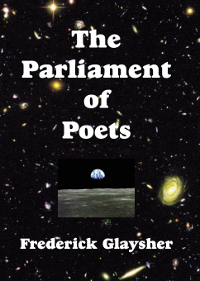
The Parliament of Poets: An Epic Poem

The Parliament of Poets: An Epic Poem

FROM the Invocation, BOOK I, The Parliament of Poets

O Muse, O Maid of Heaven, O Circling Moon,
O lunar glory of the midnight sky,
I call on thee to bless thy servant’s tongue,
descend upon thy pillar of light,
moonbeam blessings, that from my mouth
may pour out at least a fraction of the love
I hold for thee, sweet blessings, for service
to God’s creation, and His Creative Word,
the Bible’s thundering verses, Brahma
of the Upanishads, Allah, the Compassionate,
Buddha’s meditative mystery,
Confucius and the Dao. O Great Spirit
of the many peoples and the tribes,
if I have ever sacrificed for thee, long years,
drinking water from a wooden bowl,
hear my appeal and inspire me to sing
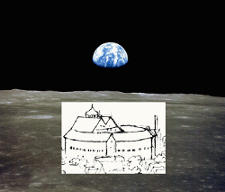
the tale supernal, upon the moon,
The Parliament of Poets, assemblage
of thy devoted ones, God intoxicated,
survey the cosmos and the centuries….

From the Invocation of the Muse, The Parliament of Poets: An Epic Poem. Copyright (c) 2012 Frederick Glaysher.

Frederick Glaysher

Leave a Comment

Filed under Epic

Buddhism and Modernity

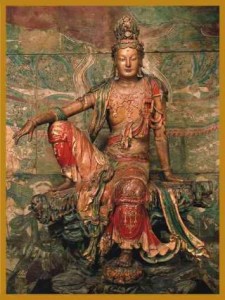
KuanYin Water Moon, Shaanxi

Kuan- yin, in “Water Moon” position, Shaanxi History Museum, Xi’an, China

Buddhism and Modernity

I find the “water moon” position of the Chinese Buddhist statues of Kuan-yin, right knee raised, with the right arm extending over the knee, one of the most beautiful and evocative in Buddhist art. That’s what the Chinese call this pose. I saw one statue of it at Shaanxi History Museum in X’ian, China, that is truly a national treasure, in carved stone, that’s very famous. Buddhism has what are called mudras, stylized hand positions and other poses, all carry various meanings symbolically. I use or refer to several in my epic poem, because for Buddhists they carry a great deal of meaning and suggestive emotion, and so on.

I finally finished my epic, and it’s available online as a hardcover and ebook formats. There’s a long section with Kabir that I hope speaks well to Sikhs, though he’s really a pre-Sikh poet. It’s his universal perspective that is important to me. I think much of that spirit is what the world needs today, globally, East and West. One of the qualities of modernity is the rigidity of its abstractions, whether East or West, codifying its disjunctions. They often stand in the way, barring a deeper understanding of modern experience than the knee-jerk nihilism of the academy, chanting its mantra of the “Enlightenment,” just as bigoted, isolated, extremely fragmented and convinced of the truth of its exclusivism as any Christian fundamentalist.

Whose Buddha? Whose West? East? Modern life is much more complex and fluid than the traditional categories and the attempts to “return,” “restore,” “recover,” and so forth, in each case, around the globe. The tiresome morality tale of the ascendant Enlightenment is just as flawed. Kabir, Rumi, others, speak to our time because they were early voices of the realization of Unity.

I’ve read the Tao te Ching many times throughout my life. To my mind, one who has spent his entire adult life reading in all the religious and literary traditions, East and West, and lived in Japan, traveling all over China, the “categories” are not as tight and neat as many argue… especially on the lived, human level. Given modern experience, I have often thought, What’s the difference between going back to Jesus, back to Lao-si, or back to Buddha?  The idea of *exclusive* truth, East or West, is a misconception. I believe the realization of Unity, as in Rumi, Kabir, and others, human oneness, is a much more profound response to human experience, especially given all the upheavals and change that marked the 20th Century.

Ultimately, while it may, has, and will appeal to some, Buddhism is not compatible with Western civilization, which has usually always been a highly active and vigorously alive culture.

There’s a rare article on the realities of Buddhism in much of Asia, on the ground, as it is often lived, or not, in The New York Times. Of course, though, typical of The New York Times, one might say… yet this is the Buddhism I witnessed, at times, in Japan, thirty years ago, as later in China, and this experience runs throughout the modern literatures of Asia, as I suggest in my book The Grove of the Eumenides.

Frederick Glaysher

Leave a Comment

Filed under Universality

Post-Gutenberg Book Launch

The Parliament of Poets: An Epic Poem

The Parliament of Poets: An Epic Poem

Post-Gutenberg Book Launch

Initially, after such a long time of study and writing, I think the Post-Gutenberg launch of The Parliament of Poets is off to a good start. There has been a considerable amount of interest in the book through social networking and otherwise, on Facebook, Google+ and so forth. A fair number of review copies, digital and hardcover, were sent out during the summer; the summer serialization resulted in people hearing about the book and purchasing individual chapters for 99 cents apiece; many editors and intelligent readers have responded into the fall, and hardcover copies are selling. I managed to contact much of the old traditional review magazines, journals, and newspapers that count, in terms of serious literary discussion and interest, or thought of as such by many, and gave them the opportunity to consider and review what I believe can only rightly be recognized as what it is–the first global, universal epic poem, and the first epic poem in the English language in 345 years, though I’m well aware that it’s up to critics and readers to judge it. Inevitably, I am the thoroughly immersed and partial author of my child.

I’ve enjoyed immensely, too, exploring the possibilities of the Post-Gutenberg moment, finding what I hope are new ways of reaching readers and the culture, of making my book available for readers, as we all try to figure out where and how we go from here. It’s a very exciting time to write, just from that perspective.

I’m grateful, too, that there has been some interest among South Asian Indian readers and journals. While Robert Frost, Ezra Pound, T. S. Eliot, and so many other American writers, had to go east, back to the old world, if you will, to find and receive a hearing, I have always felt and experienced an attraction to Asia, Japan, China, and India, on many levels of my being. That interest is reflected in my epic. Often I have thought that perhaps for me, if anything like recognition ever finds me, maybe it has to come first somehow from Asia, given what literature and the academy have so often become in the US and Western world.

When I look back at 2012, I can only think it’s been a remarkable year for me, quite a journey on the lived level, really, covering a lot of ground, reading my epic as I finished various drafts, in Buffalo and Albany, and then in Austin, Texas, a number of  times. With the epic finished and setup worldwide in hardcover and digital formats, I hope somehow in 2013 to be able to travel more and begin to live my dream of reading and reciting it throughout first Michigan and the United States, and, God willing, around the world, becoming a modern exemplar of that rhapsode on the Berlin Painter’s great and matchless amphora.

Frederick Glaysher

Leave a Comment

Filed under Epic

Now an ePub on Kobo and Google Play, The Parliament of Poets

The Parliament of Poets: An Epic Poem

The Parliament of Poets: An Epic Poem

Now an ePub on Kobo and Google Play, The Parliament of Poets

Kobo (many devices, iPad, smartphones, tablets, etc.)
https://www.kobobooks.com/ebook/The-Parliament-of-Poets/book-o0H_nhEHWkqOyyVMFD1LWg/page1.html

Google Play (many devices, iPad, smartphones, tablets, etc.)
https://play.google.com/store/books/author?id=Frederick+Glaysher

Both ebook sellers have numerous affiliates around the world and with time availability of my epic poem will spread to them as well. They both also provide their ebook list to independent booksellers and local bookstores in the USA. For one list, see IndieBound.

With the full setup now on Kobo and Google Play, I consider my epic poem fully published and distributed. I don’t anticipate making it available through other outlets. I have all the bases covered, if you will, to my satisfaction–Amazon, hardcover and Kindle; Barnes & Noble, Hardcover and Nook ePub; Kobo, ePub; Google Play, ePub. Through Ingram’s Lightning Source, the epic is available worldwide, or will be soon, as a hardcover book, through many booksellers in the USA, the United Kingdom, all over Europe, Australia, New Zealand, Japan, Korea, India, and many more locations. For specific countries, see my web site page, Order Books.

I don’t really like the way Apple allows independent publishers to place their books on iTunes, i.e., through Smashwords, which has a stigmatizing association that I don’t think highly of and uses what I consider to be an inferior format to the ePub2 that I want my ebooks published in. The reader deserves the best. If iTunes were to allow writers to publish directly through an Apple account, I would then make my books available on it. Unless or until that happens, readers with Apple devices can read my ebooks through the apps for Kobo, Google Play, and Kindle, or the hardcover.

Frederick Glaysher

Leave a Comment

Filed under Epic