The Globe
msgbartop
The Post-Gutenberg Age. A Writer’s Online Journal. Frederick Glaysher
msgbarbottom

22 Jul 10 Paternal Haplogroup R1b1b2a1a2

Altamira Cave, Spain

Paternal Haplogroup: R1b1b2a1a2

In 2010 my oldest son had his genome DNA tested showing the
Paternal Haplogroup reaches back to Gascony in Southern France and the Basque Region of Spain, as far back as  20,000 BCE, the time of the paintings in the Lascaux and Altamira caves. According to 23andMe.com, “R1b1b2a1a2 is found in the Y chromosome, a sex chromosome found only in males. It is passed from father to son.”

The surprising thing about our genome to me was that I have all my life been fascinated by the ancient cave paintings in Lascaux, have read everything I’ve ever happened upon about them. I can remember in the early ’70s, in a humanities class, viewing and discussing a movie about the caves. For most of my life, to my mind, the human time scale they represent especially served as a reminder of the longevity of humanity on this planet. They naturally became a part of an epic poem I’m writing, The Parliament of Poets, with my writing about Lauscaux nearly two years ago. All the more astonishing to me to discover there’s a marker in my genes going back to the Basque region.

I’ve usually identified most with my English heritage, though I’ve always known of several other strands of genealogy, some back into the early 17o0s, German, French, Irish, and Croatian.

Over 20,000 years is so incredible that any mention of genealogy becomes absurd. The only rational conclusion is that I’m a human being.

Frederick Glaysher

  • Share/Bookmark

Tags: , , ,

08 Jun 10 Borges. A Signature.

Borges. A Signature.

Borges. A Signature. June 8, 2010.

Life becomes a Borges story. For a few months I’ve been reading and writing about Jorge Luis Borges. This afternoon, tidying up my study, I stumbled upon a used paperback copy of Borges On Writing, 1973, which I bought in Ann Arbor, Michigan, during the winter, and sat down to read it. His signature is on the title page! It looks a lot like this one online for $31,000!

Surreal, South American magic fiction kind-of-thing… Of the couple of thousand books I have, I’ve never found any other signed copies… of the thousands of books I’ve read from libraries during my life I’ve never stumbled onto a signed copy… and then to find the only one that is signed by someone I’ve been thinking and writing about for months is strange. I like to think I’m largely a rational person, realizing it’s merely coincidence, but it’s still surreal, given all his surreal, bizarre stories and poems…

Here’s another sample Borges signature, for an incredible $18,000.

The same flourishes of the “g,” capital “B,” and his characteristic upside down “T” at the end. What does that signify? Some transcendent symbol? A mystic alef of his mind? A shakiness in the cramped hand, blindly struggling to sign the book held in the air, held inches from the eye, the way Bob used to? Another blind master…

Why do writers and artists always have to die before their work starts fetching these kinds of prices? Some crude, bourgeois calculation involved.

I’ve scanned it in. Somebody tell me I’m wrong!

After the 1973 publication of  Borges On Writing, he was at Michigan State University twice, in 1975 and 1976, the latter for a full semester, during which he spoke or read at other colleges in Michigan. It’s doubtful that the opportunity wouldn’t have arisen for Borges to read at the University of Michigan, my alma mater, and the major, international university of the state, in Ann Arbor. A student or faculty member, working his or her way up the line, for his signature, a signed copy, unknown to his family or heirs, forgotten, dumped into one of Ann Arbor’s many used book shops, for a few bucks… or a student, as poor as I was once, needing a meal…

“Uncanny,” as a Facebook friend has said. The word surreal keeps swirling around in my head… For some reason, Borges’ story “The Approach to Al-Mu’tasim” has also kept coming to mind, since my discovery, his search for Attar’s Simurgh, which all connects intimately with a poem I’ve been writing.

There are times when the intuition can surpass and lead aright the rational mind. Perhaps a fellow writer can help us more than we are able to understand, reach out even from across the grave… how non-modern, how contrary to our quotidian, rational assumptions, modernity’s cliches and distortions, petty pieties.

Through the mirror, through the mirror, to the next continent, somehow, through the mirror…

Frederick Glaysher

  • Share/Bookmark

Tags: , , , , ,

22 May 10 Borges. Moon Mirror. Mirror Moon.

Earth, Africa, Apollo 11

Borges. Moon Mirror. Mirror Moon.

On the pampas. Buenos Aires. “O Poet of the Moon!” Under the Southern Cross, bitter juntas of the soul.

And so I find myself standing before what I’ve thought of for decades but have not been able to confront, write about. Thinking of it, year after year. An omnipresent obstacle, challenge, too hot to handle, stepping around it, sensing always its presence, why me, why me, who assigned this to me? A choice, an answer to a call, by default, delegation, destiny, long refused, evaded, a sense of futility overwhelming, filling me with a loathing for its very terms, find another scapegoat….

Mirror moon draws me in, and I cannot refuse to go, on to another continent… time come… its arduous demands, relentless, sacrifice of self, safety and content, all past, receding, far away now…

Frederick Glaysher

  • Share/Bookmark

Tags: , ,

27 Mar 10 Passage to the Americas.

Passage to the Americas

Passage from India. Passage to the Americas. Walt captains the Persona back from the “streams of the Indus and the Ganges.” “Circumnavigation.” Pacific blue.

I had not intended it. The thought hadn’t even occurred to me. It was a discovery of the writing itself. The journey was so arduous I had wanted to end it in India, go back to the moon… “have done, have done, with every vain, dinning complexity.” I might have thought of it a few times, but always dismissed it, couldn’t see a way through South America.

And then I stood on the pachisi courtyard. Alone. Believing it was time to return to the moon.

Borges opened the door, showed me the way, my reading of him, forty years ago, overwhelmed me to my utter amazement. The structure through the struggle. Neruda’s “The Heights of Machu Picchu,” Octavio Paz, Archibald MacLeish’s “Conquistador.”

Mayans, Aztecs, Incans. Argentina’s “disappeared.” Borges, through a mirror…

Frederick Glaysher

  • Share/Bookmark

Tags: , , , , , , , , , , ,

27 Jan 10 Emperor Akbar. Fatehpur Sikri.

Emperor Akbar. Fatehpur Sikri.

Emperor Akbar. Fatehpur Sikri.

Emperor Akbar. Fatehpur Sikri.

January 26, 2010

The Mughal emperor’s Pachisi Courtyard. In front of the Ibadat Khana, House of Worship.

Akbar’s court poets Faizi and Urfi receive the Persona. Rabindranath Tagore, Amir Khosrow, Kabir, Bulleh Shah, Lalan, and Sarmad, the wild Persian-Jewish convert to Sufism, dressed like a Jain. The mystics and Sufis of India mix and consult. Vyasa, Valmiki, and Tulsidas look on. Persuaded by Tagore, given the trials of the time, Rahman Baba, an Afgani Pashtun, comes down from his mountain village to confer with the poet from the moon. Satya Pir, Dihlawi, Fani Kashmiri, Brahman, Panapati. Evoking the majesty of human history, Lord Alfred Tennyson extols Akbar’s dream.

The many oceans mingle. The dancing girls on the Pachisi Courtyard.

Frederick Glaysher

  • Share/Bookmark

Tags: , , , , , , , , , , , , , ,

14 Jan 10 Attar. Conference of Birds. 7 Valleys.

Attar through 7 Valleys

Attar through 7 Valleys

Attar. The Conference of the Birds. Seven Valleys.

January 14, 2010.

Attar and a soaring flock of birds lift the Persona, from the plain of Konya, onto another plane. Through Seven Valleys they fly, from Tabriz to Sulaymaniyah; Shiraz and Hafez, to Nishapur, Khorasan, on the Silk Road; Ferdowsi and a tear over Iran; Alexander’s Bactria and Kandahar; down through the Kyber Pass, Seven Valleys of the Soul, down into India and the plain of Agra. Leaving the poet before Emperor Akbar’s city of Fatehpur Sikri, standing alone, before the lake.

Frederick Glaysher

  • Share/Bookmark

Tags: , , , ,

06 Jan 10 Rumi. Mevlana. Konya.

Rumi. Mevlana. Konya.

Rumi. Mevlana. Konya.

Rumi. Mevlana. Konya.

A house in Konya, ancient Iconium, where St. Paul preached the Gospel. Around and around. Ethereal music and chanting. Another world. Around and around, a pole in a house, Rumi in another world, longing for the Beloved, the scent of her tresses. And then he stopped and asked a question.

We walked through fields of flowers to a riverbank. A reed pulled from its source.

Attar and a flock of birds lift the Persona from that Valley of Search.

Frederick Glaysher

  • Share/Bookmark

Tags: , ,

06 Nov 09 Tolstoy. Yasnaya Polyana.

Swirling Tunnel of Time

Swirling Tunnel of Time

Tolstoy. Yasnaya Polyana.

Wainamoinen,  along with Sigurd, Beowulf, and the Valkyries, lift the Persona from the Isle of green to a grove of green, turning toward early fall, as through a swirling tunnel of time, to a birch bench. Tolstoy guides me further along the path, discusses his religious beliefs, mourns his mistakes, grieves Russia’s collapse into the crevasse of modernity. Two young poets swept away into the gulag emerge to carry the Persona from Russia, with Hadji Murad, heading south.

Frederick Glaysher

  • Share/Bookmark

Tags: , , , , , ,

02 Nov 09 London. Englands Green.

Englands Green & Pleasant Land

Englands Green & Pleasant Land

London. Englands Green.

Browning’s poem Christmas Eve especially opened the door for me, finally walked through, after decades of thinking about it. Browning and Tennyson before Westminster Abbey. A cordial reception and then a dressing down. The Federation of the World.

Blake and Milton walk together over from St. Margaret’s Church and join us. My master guides me to what Blake called, so rightly, “Englands green & pleasant land.” A simple parish church. Surrounding graves. A church perhaps Thomas Hardy had restored, in need again of his services. A prayer.

And the Lady of the Lake. A thrush, not darkling now, though it were. Excalibur. Arthur returns. An inscription on the shining blade.

Frederick Glaysher

  • Share/Bookmark

Tags: , , , , , ,

22 Oct 09 Chartres Cathedral. Dante.

Boot of ItalyHaving thought of Chartres Cathedral and Dante for more decades than I can remember, I consider it a blessing  that he chose to guide me there. The Queen of Heaven, to whom I prayed as a child, found me, I hope, not entirely unworthy of her grace and mercy, though we human beings, from that perspective, are always undeserving. Europe, a hallowed tale, in colored glass.

One always wonders how to go on. How from here. But one does somehow. Through the labyrinth. On one’s knees.

Back in London, so soon. Outside Westminster Abbey.

Frederick Glaysher

  • Share/Bookmark

Tags: , ,

13 Oct 09 Job. Hebrew Poets. Baal.

An Ash Heap of Moon Dust

An Ash Heap of Moon Dust

It took months of study, thought, reflection, and prayer, but I found my way forward, rose from zazen on the lunar platform, spoke with Job on an ash heap of moon dust. The Hebrew poets of Andalusia widened the perspective, with Hanagid directing Yehuda Halevi to guide me below to Mt. Carmel and Elijah’s slaughter of the prophets of Baal. Dante lifted the Persona from that scene of horror, flying up the boot of Italy, into Europe….

Frederick Glaysher

  • Share/Bookmark

Tags: , , , ,

28 Sep 09 Ben Jonson. Bartholomew Fair.

Having seen Antoni Cimolino’s production of Ben Jonson’s Bartholomew Fair a few weeks ago, I find myself continuing to think about it. A rare play rarely played, Jonson’s comedy, like Shakespeare’s, offers its audience a serious vision of life in all its plenitude, letting the hot air out of everyone. Cimolino gives the play a marvelous interpretation, bringing it to life for our own time. After seeing the play, it was a shock to learn that the Stratford Festival production was the first performance in North America. Bartholomew Fair deserves to be much better known.

Bartholomew Fair was a yearly event in London, held from 1133 until 1855, when it finally came to an end. In Jonson’s day, it attracted large crowds of people from all walks of life to its four days of commerce and carnival, in Smithfield, a less desirable part of London.

Rather than a synopsis, available elsewhere, what interests and fascinates me about Bartholomew Fair is its vision of resolution. The play is stocked with cut-purses, prostitutes, nitwits and fools, wooers and wooed, sanctimonious Puritans and scheming characters of all types. Judge Adam Overdo, a justice of the peace, dons a disguise and infiltrates the fair to spy for himself on the lower echelons of society that he deals with daily in court, to understand them better, and to note “enormities” for prosecution in many cases. Yet Jonson reveals Overdo to be as false and hollow as all the other characters, that is to say, human. From high to low, none are without flaw and failing, all are put under satire’s cutting instrument.  More than a morality play, the fullness and vitality of life are thoroughly explored and enjoyed,  the delight of existence, all its antinomies opened to view, wisdom and delight. Tom Quarlous says to the Judge at the end, “Remember you are but Adam, flesh and blood! You have your frailty; forget your other name of Overdo and invite us all to supper.” In an act of acceptance and humility, rather than benevolence, at the end of the day and play, Judge Overdo invites everyone to dinner at his own home, all passion spent.

A marvelous production. Juan Chioran’s portrayal of the Puritan Zeal-of-the-Land Busy was brilliant. I would say one of the reasons the play probably fell into obscurity during the 17th century was Jonson’s scathing satire of the Puritans. Even if the theatres had not been closed, it would have been too hot to handle under Cromwell and so forth. I hope Antoni Cimolino’s revival of the Bartholomew Fair leads to more appreciation and other productions. Perhaps our time is one that can enjoy and hear Bartholomew Fair. The play deserves to be high in the canon of 17th century drama and is a refreshing change of pace from Shakespeare, while sharing some of his best qualities, especially the Elizabethan resolution of all orders, an impressively humane and gracious ending, one worth pondering.

Lucy Peacock’s Ursla the Pig-Woman, an enormously obese vendor of cooked pig, as well as a provider in her tent of other human wants, was outrageously funny at times, though a minor character. Having attended plays during most seasons at the Stratford Festival for the past decade, I couldn’t help but recall her in other performances, which I much preferred, though I suppose it is the role Jonson wrote. A tremendous cast, Cliff Saunders performance of Lantern Leatherhead’s puppet play of Hero and Leander was hysterically funny. He had me laughing almost to tears. A wonderful experience. A vision.

Frederick Glaysher

  • Share/Bookmark

17 Sep 09 The American Scholar – Decline of the English Department

Having read The American Scholar for probably over thirty years, I could only feel the most seething contempt for the Autumn 2009 article by William M. Chace, “The Decline of the English Department: How it happened and what could be done to reverse it.”

I found myself repeatedly thinking while reading it, is this all you can come up with? What do you expect? The American English department is thoroughly sunk in doctrinaire nihilism and cynicism, as are all of the humanities, indeed, modern culture. We don’t believe there’s any value, meaning, or purpose to life. Who in their right mind would want to spend their lives studying the idiocies that the humanities have given themselves to over the last decades? I didn’t in the 1980s when I found myself subjected to bumbling fools prating about Derrida and the End of Everything, while composition “specialists” we’re busy draining off, in their own way, anything worthwhile to write about. Clearly fewer and fewer young people are interested. Good for them. There’s hope after all. Unfortunately, that leaves most of them grossly illiterate and nescient about human civilization. But that’s what you ultimately get when you have coercion of conscience by tutors, clerks.

William M. Chace does not ask a single, worthwhile question about why the decline of the humanities has taken place, but only gives the reader the usual academic platitudes, which I’m not even going to repeat, they’re such a common coin, an old tale retold now for decades. How nauseating. The corrupt, coercive system deserves to decline, indeed collapse. Only then is there a small chance that people both inside and outside of the academy might begin to ask truly serious questions and seek truly serious answers. There’s nothing serious about university studies today. With this article, The American Scholar has proven it for anyone in doubt.

The professionalization of literary studies has been disastrous. Who was it who said so many decades ago that the Ph.D. would destroy education? It definitely has. It’s put ignoramuses, time-servers, and goose-steppers in the classroom in endless droves. Why is anyone surprised that they have burned down the Sacred Grove?  They’ve destroyed literature, turning it into an academic plaything.

And who has assisted them? Worthless, illiterate university administrators, more interested in cynically maximizing profits, exploiting teaching assistants, professors, and everyone else on campus, sucking the juice out of state and federal funding. Having lost all sense of the duty to morally and spiritually cultivate students, administrators allow them to flounder along, happy to continue to raise costs and keep the money flowing in, often to themselves.

It’s our whole vision of life that has become exhausted, not merely the English Department. William M. Chace’s criticism of the fragmenting of the humanities into sub-disciplines obsessed with gender and ethnicity is an accurate assessment, but an old one by now. How do we recover what we have in common as human beings and humanists? You won’t find an answer in The American Scholar or any other academic journal.

My advice? End Ph.D. programs, corrupting organizations like the MLA (Modern Language Association), all MFA (Master of Fine Arts) programs, “studies” departments cannibalizing both intellectual life and what humanity has in common. Once that’s done, literature (anyone remember what that is?) might stand a chance to recover a noble, inspiring vision of the human being. If that’s beyond conception, reread Tolstoy’s What is Art? He may have been under the strain of fighting the drift of early modernity, made many errors, but at least he went down in battle, and is much healthier than the academic types one finds in American English departments. Russia would have been much better off if it had followed Tolstoy, instead of Lenin. Academicians themselves have declined, while whining about anti-intellectualism and philistines whenever they’re met with real criticism, instead of sycophantic students desperately working on their Ph.Ds, though that seldom happens since they keep themselves so isolated.

William M. Chace’s closing comments are feeble, if not pathetic. Aesthetics? We’ve been there for centuries. All recipes for further decline, accommodation, etc. Let’s not feel bad. Let’s put on a happy face. Sad but revealing of how bankrupt educated discussion has become.

Here’s a novel suggestion not seriously considered in most academic departments for some time now. We need to pray, to love God, and to seek out his will for humankind, in our day and time. Not as an academic “idea” or theory, but as a reality in our inmost heart and soul. We need to return to life the serious purpose that only a religious, spiritual vision provides, though pedants think it’s their raison d’etre to strip young adults of it should they present upon entry into college. This change of heart is needed not merely in the university, but rather throughout modern, Western society, indeed East as well as West. I am arguing not for a simplistic return to Christianity or any one of the great religions, but to what lies at the core of all of them–the Divine Being beyond the ability of the human intellect to fully understand, but within our ability to experience through prayer and worship. Then, literature might again offer a vision worth studying.

Frederick Glaysher

  • Share/Bookmark

Tags: , , ,

11 Aug 09 Westminster Abbey Evensong

England

England

Westminster Abbey Evensong

“Through many tribulations we must enter the kingdom of God.” Acts 14.22

While visiting England for ten days at the end of July, I attended Evensong with my wife in London at Westminster Abbey. For an American it’s a rare experience to be in a building, let alone a cathedral, that’s over a thousand years old. In Michigan there’s little that extends back before the 1860s to1880s. Yet much of our trip included pilgrimage, as it were, to one ancient site after another, central to civilization and English literature, and several other buildings three to five hundred years old. The time scale itself is fascinating, humbling, elevating. Rising heavenward into vaulted ceilings, the columns of Westminster Abbey ascend. Prayer in stone and song resound from the quire. Hearts reach towards God. Thanksgiving beyond the murmuring of words.

In Japan and China, I had been in many temples, pagodas, and other religious sites that were several hundred years old and older. Westminister Abbey, dedicated in 1065 AD,  was the first experience I’ve had of Western sacred ground of comparable antiquity and worth. There are some poets entombed and memorialized in the southern transept.

Having reread the Book of Acts and the writings of St. Paul and the other apostles, prior to setting off for England, along with a lifetime of reading English literature and history, I felt prepared and fortified for the journey. Life as it is lived, on the ground, on planet earth, always plays a crucial role in one’s education.

Frederick Glaysher

  • Share/Bookmark

Tags: , , , ,

09 Jun 09 Pray to your Father

The Whirlpool Galaxy, M51

The Whirlpool Galaxy, M51

“But when you pray, go into your room and shut the door and pray to your Father who is in secret; and your Father who sees in secret will reward you.” Matthew, 6.6

I was very young when I first read these words of Christ. I knew they were true, felt them deeply, as I still do. They guided me the right  way, when much else was often in doubt. They guide me now too. They teach humbleness and sincerity before God, closing the door to the distractions of the  world, communion with Him alone. All the prophets and teachers of the great religions, including  Baha’u’llah and Abdu’l-Baha, similarly extol prayer and meditation. The guidance and example of the Bahai prayers deepened, strengthened, opened my soul to the Divine.

In times when we are lost, the best thing we can do is follow Christ’s teaching, withdraw into prayer, find our way through worship of the Divine Essence, the peace and stillness found in surrender to the Mystery of Being; await there for the still small voice to pick us up and lead aright. As Plato wrote, first a shudder, and then the old awe pours over one.

Rereading this spring the four Gospels, I savor again transcendence and its vision of spiritual and moral perfection, the surest guide, down to earth, while reaching to the stars.

Frederick Glaysher

  • Share/Bookmark

Tags: , , , ,

22 May 09 Gravity

Moon Ground

Moon Ground

The struggle, so intense. I had thought it would be relatively easy to write about the exclusive religions, since I had spent my whole life in their cultures, reading, steeped in their scriptures, theology, art, and literature. Yet now I find perhaps the opposite is the case. I know all too much, making it difficult to see and select what is essential or evocative in the right way, though that’s not really it, either. Rather, the scope is so challenging, the embrace so wide, the view from the moon so vast, it’s often overwhelming. And it’s the pain, pain and despair, of facing the blank page every day, trying to resolve the many strands into one. The enormous study and reflection required, so many years, solitary, my study feeling at times like a dungeon, a deep, dark, black pit. Easier to walk away, avoid it, the feeling of talking only to one’s self, dispiriting. Weakness and the dread pull of inertia. Gravity, even on the moon.

Frederick Glaysher

  • Share/Bookmark

Tags: , ,

25 Mar 09 Back on the Moon

Lunar Module, descent stage, left behind on moon, top left

Lunar Module, descent stage, left behind on moon, top left

Past the Kingdom of Silla, to the mountains of Lake Biwa, where Basho and Saigyo rested from their long journeys. Like all of Japan, the view of the lake has changed since Basho was interred at the Temple of Gichu-ji on its southern shore. Saigyo guided the Persona back to his great metaphor, the moon:

In the mountains’ deep
Places, the moon of the mind
Resides in light serene:
Moon mirrors all things everywhere,
Mind mirrors moon . . . in satori now.

(Tr. William R. LaFleur)

Basho too taught the Persona the oneness of his vision, a Vinegar Drinker in his own way:

Four gates
And four different sects
Sleep as one
Under the bright moon.

(Tr. Nobuyuki Yuasa)

Frederick Glaysher

  • Share/Bookmark

Tags: , , ,

09 Mar 09 Soaring above Mt. Tai

Mt. Tai from the Moon

Mt. Tai from the Moon

It was an arduous, overwhemling journey from Bagan, Burma, up over Lhasa, Tibet to Dunhuang. Sun Wukong was my able guide, having traveled the way, though a different route. He led the Persona into the Mogao Caves, his guiding presence understood a fellow seeker. From there, he took the Persona to Chang-an, where Du Fu led him up the many stairs of the Big Wild Goose Pagoda, taught him a sweeping view of China, coming down from that tower, a different man. In the courtyard, Bai Juyi lifted him up to Mt. Tai and the Azure Clouds. I imbibed the beverage of the Three Vinegar Drinkers, savored its harmonizing nature.

Not yet back to the moon, but closer, heading east, into the rising sun.

Frederick Glaysher

  • Share/Bookmark

Tags: , , , , , , , , , , ,

20 Jan 09 A Walk around the Galleries of Angkor Wat

Full Moon

Full Moon

As I’ve journeyed through Angkor Wat and Cambodia, the antinomies have further clarified, on numerous fronts, including modernity. Broadly speaking, I can now see as never before the three major traditions of exclusivism and those of non-exclusivism in sharper detail, contrast, and comparison. That wasn’t really my intention, so I’m  surprised that it’s happened. Partly, I think, it’s in the material itself. The attempt to find and give it form brought it all out.

So there are vistas I’ve never realized before. As with Hinduism, the complexities and teachings of Buddhism have been fascinating to study once again, its various interpretations and flavors. Another surprise has been that the Internet has proven an invaluable tool for study and for finding the right historical nuance and detail, especially on the more human level of lived thought and belief, opening the antinomies ever deeper into the soul.

Though only on the way to Dunhuang, now in Bagan, Burma, I look forward to the Mogao Caves, visiting them again, as with Chang-an, and Japan. Saigyo shall guide me back to his great metaphor.

Frederick Glaysher

  • Share/Bookmark

Tags: , , , , , , ,

06 Jan 09 A Journey through India

The Lesser and Greater Vehicles

The Lesser and Greater Vehicles

Beyond in medias res, the Persona traveled on through India, from the field of Kurukshetra to Shiva Nataraja, Kabir, and the epic struggles of the Ramayana. Hanuman has guided me now to Angkor Wat. From there the Persona shall walk with the elders and ride the greater ferry to Dunhuang and China, on to Korea and Japan.

Though daunted by the immensity of the trip before me, I trust my guides shall sustain me through the jungles and mountains and deserts. They have brought me thus far, cannot fail me now.

Frederick Glaysher

  • Share/Bookmark

Tags: , , , , , , ,

04 Dec 08 In Medias Res

Half Way to the Moon

Looking Back at Earth, Half Way to the Moon

It was the in medias res that took me decades to figure out, repeatedly pouring over Homer, Virgil, Dante, and Milton, and every other epic poet and form, struggling again and again for the right structure. I knew the plot of The Parliament of Poets was the backbone of the book itself, the very crux, first and foremost, for it to work, to draw the reader into it, and to play on the great tradition, evoke it, honor it, raise everything to a higher level of seriousness and import. It proved to be the hardest part of the epic form, a seemingly insurmountable challenge over which I stumbled, trying one idea after another, rejecting sketch after sketch, setting my notes aside knowing that way and that idea wasn’t it, wouldn’t work.

And then it came to me, while I was doing some trivial task of life, and I rushed to my study to write it down, lest I lose it after all these years. I knew I had it with the certainty of that’s it! get it down on paper, before the phone rings or whatever, before it’s gone forever–surprise, relief, elation.

With a rough draft written of the first three books, I now sense that I can finish writing The Parliament of Poets, see my way to the end of it, a sense of confidence I’ve never had before, since it was always entirely in the future, the book I would write, God willing, one day, as notes accumulated, as decades went by.

Now the challenge has become time, acquiring it, holding on to it, and worrying over the unpredictability and evanescence of life, of completing what’s begun.

Frederick Glaysher

  • Share/Bookmark

Tags: , , , , , ,

24 Nov 08 World Bible. Religions of Man.

The Moon

The Moon

It was as a young student in high school that I first encountered the scriptures of other peoples, in a class on world religions, which used The Portable World Bible. Instead of historicism, I believe I got the real message, since I did the reading, of the writings themselves, the universalism at their core. And it may have been that I was fortunate in the teacher of the class, who may have introduced me to a new style and way of manhood. Looking back, I see an intellectual man, more sophisticated and nuanced in sensibility.

And then, a year or two later, after more and wider reading, I took a college class that included Huston Smith’s The Religions of Man. That book opened new vistas, ordered things in a new way for me, even as I couldn’t really relate to the instructor, dropping the course before the end. But I had the book. And read it.  And re-read it. It was true to my experience. For soon, I had “gone off hiking into Baha’i.” But it was not “too quickly” of a decision. I had spent a few years reading and thinking about virtually every Baha’i book that had been published up until that time, 1976. I searched through several libraries from the suburbs to downtown Detroit to find them, and thought and prayed, prayed and thought, while continuing to read widely in the poets and literature.

It was more than a decade later that I heard of Joseph Campbell, through Bill Moyers’ The Power of Myth on PBS, another powerful influence, one I immediately recognized as true to my experience, re-watching it many times, reading some of his books. By 1983, I had already begun to make notes for The Parliament of Poets. Campbell’s work was startlingly congruent with where I already found myself to be, confirmed me in the direction I would take. But it wasn’t until about 1993 that I had written down, perhaps, I think now, as a result of his interview with Moyers, where I would travel.

Frederick Glaysher

  • Share/Bookmark

Tags: , , , , ,

20 Nov 08 What is Art for

Lunar Orbiter 1, 1966

Lunar Orbiter 1, 1966

What is Art for? It’s a commonplace thought that we used to know, but have lost, the answer to, along with God and other deeper dimensions of life. Materialism, commercialism, politics in the worst sense, anomie, nihilism, solipsism, and all the other fare out of the intellectual soup kitchen of modernity now provide the meager gruel of our existence. As though there were only one thing that art is for.

Before there was art, beyond the modern panoply, there was worship of the Unseen Essence, and human beings of all tribes, in every aspect of their lives, expressed, recorded, honored, intimated, found metaphors for their experience of what the Lakota Indians, for one, called Wakan Tanka, the Great Mystery.

We’ve been colleged. We’d never fall for that. After all, what was Marx and Freud and the great Enlightenment all about? What were they for? It’s either one or the other…. One is either an educated person or one is….

Frederick Glaysher

  • Share/Bookmark

Tags: , , ,

14 Nov 08 Unity of Being

Unity of Being

Unity of Being

W. B. Yeats struggled for, but never achieved, Unity of Being, seeking it throughout A Vision. For all his phantasmagoria, he could not create or renew a convincing vision, a Unity of Being.

I believe a vision can be achieved but on the moon, or from the moon–our time has seen and felt the impact of the great symbol, Mother Earth, her circling embrace, as her arms wrap around us, a celestial Rose Image, terrestrial oxymoron of the Universe.

Viewing our homeland from space, who can doubt that Unity of Being begins to return?

Frederick Glaysher

  • Share/Bookmark

Tags: , ,

05 Nov 08 Footprints on the Moon

Johnny-Come-Lately

Johnny-Come-Lately

The Detroit News headline for Monday, July 21, 1969, reads, “Footprints on the Moon!” I can still vividly recall watching, as a young boy, it happened on black and white TV, along with my family and the many millions around the world. It fired my young fifteen-year-old imagination like nothing else I had known. I had always been thrilled by the entire space program, my father having worked on making the heat shield for one of the re-entry capsules. And then the incredible event itself, in prime time TV, “one giant leap for mankind.” I was there with the astronauts, walking on the moon.

My family saved the complete front-page section of The Detroit News for that day. Eventually, it became my copy of the great event that dad and all the nation had worked for, the greatest technological achievement of human history. As the years went by, I found myself still thinking about our human visit to the moon, going back and re-reading that section of The Detroit News, as it has increasingly yellowed and frayed and brittled. The writer of the main front page article made one revealing comment which he seemed to think everyone would understand and agree with: “it was not necessary to send poets to the moon.” What? The falsehood and injustice of that comment increasingly struck me, as my study of poetry and culture deepened with the years. Who did these Johnny-Come-Latelys think they were? The hubris and arrogance of scientism seethed in that one sentence, the “two cultures” implicit in it.

Poets have been on the moon for millennia.

Frederick Glaysher

  • Share/Bookmark

Tags: , , ,

03 Nov 08 Searching for the Path

Crescent Earth, Apollo 11 on Return Trip

Crescent Earth, Apollo 11 on Return Trip

It was, I suppose, out of my reading, partly, in high school, of the religious scriptures of the world religions that my consciousness began to open up to other ways of life and thought, belief and faith, practice and sensibility. Later, in college, other classes in world religions and religious studies, Christian and otherwise, with continual reading of and beyond poets and writers, broadened my worldview, especially once I had found my way to the writings of Baha’u'llah.

Now I can clearly see that even back then I sensed the exclusivism implicit in the usual thinking about religion was not part of Abdu’l-Baha’s Interpretation of his father’s writings.  Abdu’l-Baha’s outlook was a wide and open embrace of humanity and all the great religions. He located “The Path” in all the great faiths, without the subsequent attempts by some Bahai denominations to claim an exclusive authority and interpretation. It was Abdu’l-Baha’s emphasis on the unity and universal truth of all the ways to the Divine Being, the Great Mystery, that attracted me and struck a deep resonance in my soul.

Frederick Glaysher

  • Share/Bookmark

Tags: , ,

30 Oct 08 The Globe. A Journal.

Earth, Africa, Apollo 11

Earth, Africa, Apollo 11

As long ago as a couple of decades I thought of creating a literary journal named “The Globe,” but the time never seemed right, and I knew the required effort and time would interfere with my own study and writing. Being a very solitary individual and writer, I knew too I did not possess the gregariousness and patience needed to draw together a group of people of similar worldview, literary, artistic, political, and so on, that a publication must have. From very early as a writer, I knew I was largely on my own. Only Robert Hayden and I were able to understand one another, and even then I felt he failed to confront many issues of the highest import, especially in terms of the Baha’i Faith and its cultural and historical implications. The few other young Baha’i would-be artists I knew or heard of were hopelessly naive and incapable of independent thought and reflection. There were no other people of sympathetic vision, aesthetic, moral, spiritual, political, in terms of the United Nations or a cooperative body like it, to which I could turn and work together to create “The Globe.” The prevailing ethos, as always, was entirely closed off in its conventional assumptions.

So I continued on my way. Solitude, study, reading and confronting the masters, wavering between the deepest ravages of self-doubt and despair and the highest exhilarations of vision and inspiration, writing as I could, struggling year after year to find and chart a different course, one true to my experience of life, attempting to embrace all of humanity, or as much of it as I might reach.

And now a new form comes along, over the last several years or decade, now well established, and the time is right for me to turn to and use it, enabling me to pick back up, as it were, in electronic form, the writer’s journal I left off from nearly thirty years ago, back then, after a decade of writing one. Perhaps this is The Globe I’ve wanted for so many years. And a way to speak to humankind.

Frederick Glaysher

  • Share/Bookmark

Tags: , , , ,

29 Oct 08 Crow Hunting

Earth from the Sea of Tranquility, Apollo 11

Earth from the Sea of Tranquility, Apollo 11

In my early chapbook of nine poems, Crow Hunting, from the 1970s, I found my voice and the worldview that was consonant with my experience of life, which I believe is why I’ve had to look back at it again, writing a preface for it, in order to move forward with The Parliament of Poets. It’s time I publish it now, perhaps before too long, in a limited edition.

Frederick Glaysher

  • Share/Bookmark

Tags: ,

28 Oct 08 A Tool An Instrument

Worldview, Apollo 11

Worldview, Apollo 11

Saul Bellow in his 1987 Bennington College address Summations refers to Osip Mandelstam’s comment that “a worldview is a tool and instrument, like a hammer in the hands of a stonemason.” The average reader, Bellow goes on to say, looks always for the worldview, thinking it is everything, filing away the summation, its neat, little abstractions. I would say, many writers, too, make the mistake of fixating upon the worldview, the struggle to achieve an understanding of one’s experience that is not derivative from the prevailing one, a mere reflection of the already thought and written, though so much writing merely reflects the fads of the academy and literati.

Osip Mandelstam and Bellow are right. It is the hammer in the hand of the genuine artist or poet. Painfully, laboriously forged, the tool, once achieved, is no longer to the poet what is of first importance. The work of art, beyond the abstractions and the banalities of “a worldview,” reigns supreme, leads to new states of consciousness that cannot be summed up. They are what art is about.

Art transcends worldview.

Frederick Glaysher

  • Share/Bookmark

Tags: , , ,

27 Oct 08 By about 1973

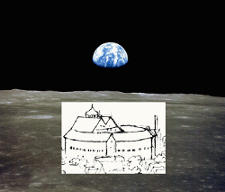
The Globe, 1647, Wenceslaus Hollar

By about 1973 I had already written, “my search for God continues.” Where had that come from? Culture? Nurture? My atrophied Catholic upbringing? Or the call of the soul within?

Frederick Glaysher

  • Share/Bookmark

Tags: ,

10 Oct 08 Beyond Postmodernism

The Globe

The Globe

Now I can see it. Now I understand. It was there from the beginning. In the earliest journals and poems that I wrote, more than thirty-five years ago.  It was the object of the vision itself that attracted me. The vision was the universal form, yet particular, and timely, capable of change and evolving, consonant with the experience of real, imperfect people in concrete situations, unique cultures and times.

Frederick Glaysher

  • Share/Bookmark

Tags: ,