Tag Archives: Frederick Glaysher

Finished the 6th Draft of The Parliament of Poets

A Long Journey

A Long Journey

Yesterday, May 18, 2012, I finished the 6th Draft of The Parliament of Poets.

Having written by hand all five previous drafts, I typed the entire manuscript of my epic poem for the first time on the sixth, revising throughout along the way. I’ve actually been quite surprised to discover I think I’m much further along toward completion than I had expected. I believe it’s really a result of my having written each previous draft by hand, which kept the poem very fluid and malleable, in my mind as well as on paper. Each sweep through allowed me to remold and revise more than I tend to once I’ve actually typed a manuscript. With a handwritten manuscript, I think I tend to concentrate on the thought and language much more deeply and am drawn entirely into it. So I’m delighted at the feeling that I’m close to a final manuscript. There are only a few short scenes, of probably only several lines, in a few places, that I want to add. Mostly, from here, I want to continue polishing at the level of phrasing and the line, nothing on the macro scale.

Having begun writing in March of 2008, at a little over four years now, I feel, looking back, quite thankful to be at the point that I am. It’s been a hard struggle, though, every inch of the way, thirty years, truth be told, my earliest notes dated 1982, a long journey. To have the poem finally out of my head and on paper is an incredible feeling. Whether the epic ever makes its way to readers or not, I have accomplished much of what I set out for decades ago.

Almost all of the notes I made over the years are also now incorporated into this draft, which I’ve worked at on each successive pass through. During the writing I had eventually arranged all my notes into folders corresponding with each of the twelve books in order to be able to handle them, on a practical level, so as not to become lost in the enormous number of themes I was trying to grapple with and reconcile. I think the method I evolved into helped to accomplish all that, and there are now very few details I want to add, everything now largely incorporated into the sixth draft. The last cache of notes and material I must go over before I’m done, during the 7th draft, is largely the epic notes I’ve complied for years on my computer, roughly arranged again by the twelve books. Most of it is less germane to the structural and thematic levels of the poem but essential in my mind as background material and thinking, so I feel I must pass through it again to make sure I’m not leaving anything out that has helped to form the poem through the years. Since each draft has required less and less time to write, I don’t anticipate the 7th to take months, but, I hope, perhaps only some weeks.

At 264 pages, formatted for a 6 x 9 book, I’ll probably add several to about ten more pages. I have half of the headnotes for each book mostly done from writing them for this blog, although quite sketchy. They will need considerable revision at this stage, but give me something to begin with. The other half will have to be written from scratch. I intend to add a short introduction of two to three pages, basically discussing my versification and rational for the form of blank verse I’ve used. My thoughts and practice of blank verse go back to my book-length narrative poem The Bower of Nil and the dramatic monologues of Into the Ruins. It is quite important to me that I have always thought in terms of reviving the epic form and creating on the technical level, as well as thematic, the means for renewal. Aristotle’s reflections on epic have been the essential influence on my own, though I would not want to leave out Longinus, Sidney, Milton, Matthew Arnold, E. M. W. Tillyard, and other poets and scholars.

I’ve thought long and hard about length. I don’t believe a modern epic can be as long as Vergil or Dante’s 12,000 to 19,000 lines. Even Milton at 10,565 lines is too long, in some books, for most readers, especially people without a literary background, of varying English command, which would be a very hard ordeal and take the enjoyment out of it, and there are such people who read Milton. I want to reach all of them, too, so I’ve intentionally carved down the form to about 8,600 at the moment. I have much that I want to say to international readers as well as in the West. I’ll add another hundred or so lines, still 9,000 or less total. I believe form and symmetry are more important than length. Aristotle’s old saw about the poet choosing the right details and so on have always remained in my head. Focus and selection, to help the reader pick up the epic and read the whole thing is more important than length.

I think, too, since the epic covers the major regional civilizations, religions, and literatures around the globe, the book needs a glossary of some terms, even though I’ve tried to use those that are already fairly well known and universal. Inevitably, for some readers, especially given the extent to which academic specialization and nationalistic insularity narrow perspective, a glossary would help other readers. One of my concerns in writing a universal epic has always been the difficulty in reaching and helping a reader understand the scope of the poem itself. I believe I have found and used many strategies to accomplish that while circumventing the poem becoming a research project, instead of keeping the narrative flow engaging the reader.

My goal at the moment is to aim for the epic to be completed by July 1, 2012, with a publication date of November 1. I believe I can adhere to this schedule and hope to have review copies available for select readers by very early July so that they might have two or three months to read and consider it, reviewing it if they feel so inclined.

For nearly half of Book III, watch my two poetry readings on YouTube. First, to view in sequence, watch the one at the Albany Word Fest, then the one at the Buffalo Small Press Book Fair:

“I found myself sitting in my study, dozing
over a book, Cervantes’ Don Quixote…”

https://www.youtube.com/playlist?list=PL21F9D6C4DA6FE818

Frederick Glaysher

Leave a Comment

Filed under Epic

The Decentralization of the Post-Gutenberg Age

ebooks, eReading

ebooks, eReading

The Decentralization of the Post-Gutenberg Age

‘E-books make the Gutenberg system, which still characterizes the industry after 500 years, absolutely obsolete,’ insists Jacob Epstein, the veteran publisher who invented trade paperbacks and founded the New York Review of Books.” “E-publishing radically decentralizes the marketplace,” Jacob Epstein.

The decentralizing of  post-Gutenberg publishing is something that I can speak about with intimate knowledge and ties in with my book of poems Into the Ruins and other books. In the mid nineties I became disgusted with the conventional avenues of cultural and literary publishing, both books, journals, and magazines. I had more than a decade of rejection slips from ignoramuses who demonstrated not the slightest understanding or familiarity with the manuscripts I sent them, along with a number from highly respected editors at major publishers, one, for instance, telling me he thought my book The Grove of the Eumenides should receive a hearing but did nothing to make it happen. I came to think very little of nepotism, especially in publishing. Other editors, publishing their post-modern drivel, enjoyed indulging themselves at my expense, they apparently thought. I quite consciously walked away from the whole conventional publishing scene, and the university in 1996, and began seeking ways to go around the stranglehold of both, directly to the reader.

I first thought the way to go around the decadent post-modern establishment and open a new path for literature, seeking to revive and renew its deepest humanistic traditions, was the time-honored route of typical self-publishing and brought out Into the Ruins through the printer McNaughton Gunn in 1999 under my own independent publishing company, Earthrise Press. While I sold some books through Borders and Barnes & Noble, through Baker & Taylor, I found them all to be opposed to an independent voice. A selection from the approximately twenty Reviews from that time are on my website. Despite a few insightful reviews, no one really understood what I was fully attempting with Into the Ruins. Thus far, the same has proven to be the case with The Bower of Nil in 2002 and The Grove of the Eumenides in 2007.

Along the way, I evolved into using POD (Print on Demand) technology through Lightning Source and thought the way around the stultifying post-modern status quo would lie in that direction, which nevertheless opened up the way to the global reach of the Internet booksellers to an amazing degree, shocking me that I could sell books around the world. Very early I recognized the value of Jason Epstein’s Espresso Book Machine, though it’s yet to fulfill its potential.

Along in there, too, ebooks increasingly became a possibility, and I published all of my books into ebooks, available worldwide and going around all of the conventional gatekeepers. The record of much of the evolution of my thinking is in my Publishing in the Post-Gutenberg Age
https://www.fglaysher.com/Post_Gutenberg_Publishing.html

Like everyone else, I’ve evolved along the way with a website since 1998 and a blog, eventually Web 2.0 social networking… Facebook, Google+ and Twitter.

Through all that, I continued to study and work towards my epic poem, the earliest notes for which are from 1982, recently finishing the fifth draft in March of 2012. It’s not only the methods of publishing that I’m talking about, but how the identification and promotion of disparate views and visions of life, in literary terms and otherwise, evolve and reach the broader culture. I have not devoted over thirty years of my life writing an epic poem to allow a corrupt, conventional corporate publisher ever to touch it. Everything I’ve written is about the freedom of the individual soul, and the poem must be published in such a way as to affirm it.

Frederick Glaysher

Leave a Comment

Filed under eReading, eBooks, Universality

Poetry Reading, Albany Word Fest

My reading from the fifth draft of my epic poem The Parliament of Poets at the Albany Word Fest, Saturday, April 21, 2012, in Albany, New York, at the Albany Public Library. Copyright (c) 2012 Frederick Glaysher. From Book III, still on earth, in the midst of things… the birds and hoopoe, and so forth.

Frederick Glaysher, Albany Word Fest, April 21, 2012

https://youtu.be/CJ_xbSXbN7k

Frederick Glaysher

Leave a Comment

Filed under Epic

Sixth Draft, The Parliament of Poets

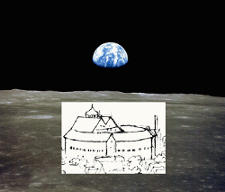
Earthrise Bubble

Earthrise Bubble

I finished the fifth draft of The Parliament of Poets at the end of March, so it’s on to the sixth… I think I now have to type it up because on the last pass through I discovered I had written the same several-line incident twice, in different books! I suppose, running around in my head, I wanted to be sure I worked it into the poem. Anyway, I’ve decided writing seven drafts by hand is no longer the way to go. I have probably over 98% of the poem on paper and need to be able to search the text to avoid repetitions and polish foreshadowing, things like that. Why not take advantage of technology Tolstoy didn’t have?

Also, I found reading from Book III in Buffalo, and preparing for it, that I revised passages and lines more in terms of oral and colloquial impact, though I had usually or often read the poem out loud to myself when writing the previous drafts. I think now that this is what I must do for the sixth draft. Read it as much as possible to a live audience and think and hear it, reflected back to me, really, in that way. I’ve always remembered hearing that Dickens would often try out different versions on audiences during his readings, revising accordingly. Something like that…

I’ve been astonished that I felt like the figure on the Rhapsode Amphora, lifted to that realm of transcendent song. I can not imagine ever having too much of that experience.

I’ll be reading from The Parliament of Poets at Austin International Poetry Festival in September, but two to four times a month between now and then would really help. If you know of any place willing to listen, let me know… use Contact under About.

Frederick Glaysher

Leave a Comment

Filed under Epic