

Works in Progress
Notes on progress while writing:
The Parliament of Poets: An Epic Poem >>> NOW PUBLISHED
See Homepage
"Long choosing, and beginning late." - John Milton, Paradise Lost.
The Argument
I derive this title from both Chaucer and Attar, which suggests my focus is both Western and non-Western human experience. I seek to sift, ponder, and sum up not only American historical experience but the human experience of the major regions of the globe under the impact of modernism.
The Guide leads the Persona on a Journey to meet all the great poets of the nations and to call them to assemble on the moon to debate the meaning of modern nihilism. The Parliament of Poets sends the Persona on a Journey to the seven continents to learn from all of the spiritual and wisdom traditions of humankind. On Earth and on the moon the poets teach him a new vision of life.
All the great shades appear at the Apollo landing site in the Sea of Tranquillity: Homer and Virgil from our Greek and Roman foundation; Dante, Spenser, and Milton hail from the Judeo-Christian West; Rumi, Attar, and Hafez step forward from Islam; Tu Fu and Li Po, Basho and Zeami, step forth from China and Japan; the poets of the Bhagavad Gita and the Ramayana meet on that plain; griots from Africa; shamans from Indonesia and Australia; poets and seers of all ages, bards, troubadours, and minstrels, ancient and modern, major and minor, hail across the halls of time and space. As the Guide shows the Persona crucial sites around the globe, such as Chartres Cathedral and the temples of Nara and Kyoto, the nature of social order and civilization in the regions of the past is explored. Modern twentieth century historical experience in all its glory and all its brutal suffering is fully confronted. The modern movement toward a global civilization is recognized and celebrated for the unprecedented future it opens to human beings. That transcendent rose symbol of our age, the Earth itself viewed from the heavens, one world with no visible boundaries, metaphor of the oneness of the human race, reflects its blue-green light into the darkness of the starry universe.
Undergirding my writing is the gradual, continuing development of international federal institutions. The defeat of communism and the numerous crises since then demonstrate that the slowly, painfully evolving authority of the United Nations remains the only hope for a comparatively peaceful world.
During the last several years I have read well over two hundred books on the League of Nations and the United Nations. For the most part they are dry technical manuals or histories of primary use to diplomats and scholars. Conversely, through the actions of concrete characters, epic poems interpret history. Global social and political conditions have more than sufficiently changed to warrant a fundamental reevaluation of what has become prevailing literary and cultural thinking.
Copyright (c) 2002 Frederick Glaysher
Further details:
Headnotes: The Globe: The Global Age. A Writer’s Online Journal.
"Epopee" in The Grove of the Eumenides: Essays on Literature, Criticism, and Culture.
Beyond Alexandria (Note on Homer and Virgil at bottom of linked page.)
For All Mankind 21 minutes, Mp3. Astronauts describing their experience
I began writing the poem in the early spring of 2008.
As of January 25, 2010, I’ve completed the rough draft through Book IX, of the projected twelve books. After two years of actively writing, I’m finding the mundane necessities of life are constantly intervening too much. Given mildly declining health in my mid-fifties, momento mori, I’ve decided, acknowledging the different offices of human nature, to try to remedy the situation, following the example also set by poets of the past, by seeking a Patron who understands the cultural importance of an epic and the reciprocity inherent in a dedication. Times Literary Supplement, January 29, February 5, February 12, and February 19, 2010. The New York Review of Books, March 11, March 25, 2010:
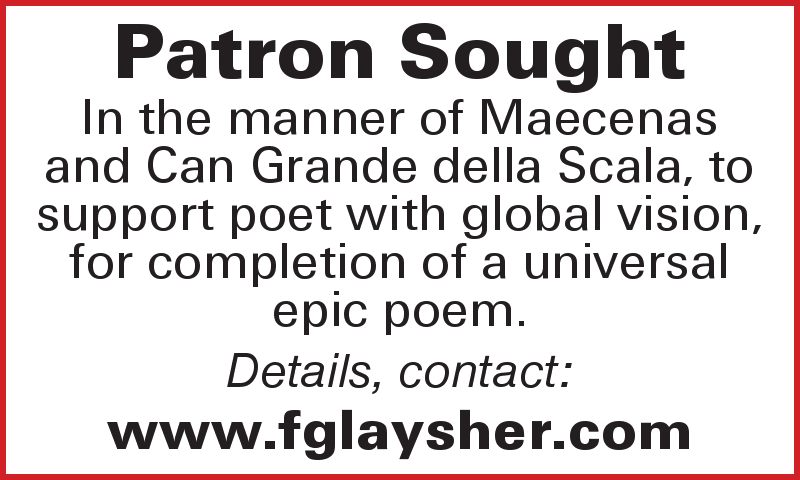

Patron Sought. In the tradition of Maecenas and Can Grande della Scala,
to support poet with global vision, for completion of a universal epic poem.
Details, contact: www.fglaysher.com
As of November 11, 2010, I've finished the rough draft of Book XI, with only the final Twelth Book left to write, set again back on the moon.
February 4, 2011. The Parliament of Poets, Book XII, after decades, nearly three years of writing, a full rough draft.
June 6, 2011. I’ve revised each book for a second draft through Book VIII.
August 1, 2011. Finished the second draft of the entire epic.
December 13, 2011. Finished the third draft, polishing the epic catalogues.
January 5, 2012. A fourth draft done, concentrating on the motif, "What is woman?"
February 17, 2012. Finished a fifth draft through Book VII.
March 30, 2012. Finished the entire fifth draft of The Parliament of Poets, after four years of writing.
May 18, 2012. Finished the sixth draft.
June 6, 2012. Finished the seventh draft.
August 17, 2012. Finished the entire eighth draft.
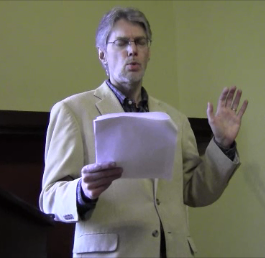
For nearly half of Book III, watch my two poetry readings below, from the fifth draft of my epic poem The Parliament of Poets, the first at the Albany Word Fest, Saturday, April 21, 2012, in Albany, New York, at the Albany Public Library. 15 minutes. Copyright (c) 2012 Frederick Glaysher.
"I found myself sitting in my study, dozing
over a book, Cervantes’ Don Quixote..."
Below, picking up slightly before the first segment above ends, taking the poem forward to the Sea of Serenity on the moon. Reading at the Buffalo Small Press Book Fair, Karpeles Manuscript Library Museum, Buffalo, New York, March 24, 2012, from Book III, in medias res. 12 minutes. Copyright (c) 2012 Frederick Glaysher.
"Who needs warp drive when I've got Queen Mab,
My escort and midwife of my dreams."
I'd welcome invitations to read from The Parliament of Poets. Please share this page or my readings with your friends.
 Published November 2012. The Parliament of Poets: An Epic Poem is the first global, universal epic, the first epic poem in the English language in 345 years, now released in hardcover, ISBN: 9780982677889; eBook, eISBN: 9780982677865. Earthrise Press, 2012. 294 pages.
It may take two to four weeks or so to move around the Internet and world, as the various online booksellers receive and set it up. Hardcover & ebooks, now on Amazon, Barnes & Noble.
Published November 2012. The Parliament of Poets: An Epic Poem is the first global, universal epic, the first epic poem in the English language in 345 years, now released in hardcover, ISBN: 9780982677889; eBook, eISBN: 9780982677865. Earthrise Press, 2012. 294 pages.
It may take two to four weeks or so to move around the Internet and world, as the various online booksellers receive and set it up. Hardcover & ebooks, now on Amazon, Barnes & Noble.
Frederick Glaysher
Contact
See the separate page for the published epic.
I am reminded of a little note I wrote once for Jack Magazine, for its 2000 review of Into the Ruins, and seek to preserve it here from the vagaries of the digital world:
Beyond Alexandria
According to the ancients, politics began with the city, initiating the struggle for larger numbers of human beings, unknown to one another, to live together in something like peace and stability, something other than chaos and anarchy. We've been at it ever since. Often failing, stumbling, hobbling along, with much backsliding, alas, many convulsions. As the building blocks have grown, we haven't always felt comfortable under the constraints, been appalled by our own failings, forged on, hoping for the best, doubting, often resisting the bitter lessons until it was too late. The city has become the globe. It shouldn't surprise us that the greatest poets, such as Homer and Virgil, cared deeply about life in the city, in peace and war, about the human condition outside their own little personal lives, took it all in as a given, rejected all the narrow, formal, stifling limitations.
-Frederick Glaysher
